Welcome to the Arizona Chapter of The International Association of Arson Investigators (AZIAAI).
The AZIAAI is Arizona's oldest, most respected association for professionals who investigate fires and arsons, professionals who prosecute or defend fire/arson cases, insurance professionals who handle fire/arson claims and crime scene professionals who process fire/arson scenes.
The AZIAAI is Arizona's authority of experts in the field of fire/arson investigations. Our diverse group of members is well acquainted with fire/arson investigations, insurance claims, scene processing, prosecution/defense.
If you would like more information on fire/arson investigations, or the services the AZIAAI provides please contact our communications director. We welcome media inquiries or requests as well as public requests for information.
2024 Annual Training Conference
Thank you to all who attended the 2024 Annual Training Conference! We were honored to be joined by the National board for IAAI and we had a lot of good training. We learned about cognitive interview techniques, smoking materials as ignition sources, challenges to expert qualifications, and the internet of things.
Thank you also to our sponsors! This would not be possible without you.
We gave out a few awards and a few tokens of thanks…….

Investigator of the year: Todd Swaim

Attorney of the Year: Amy Diederich

Frank Molina Award: Kelly Perkins


Election Results
Thank you to all who participated in our elections! Congratulations to our newest board members!
2nd VP - Casey Wood
Board Member - Nick Spezzacatena
Board Member - Darrel Tirpak
Board Member - Wes Helvig
AZIAAI 2024 Board Election
It’s time to vote for the AZIAAI 2024 Board Election!
The election will be open during the time period of : July 10, 2024 at 12:00am — July 16, 2024 at 5:00pm
Ballots can be found in your email (Ballots will be sent at 7/10/2024 00:00). Please also check your spam folder.
Nominees are as follows:
2nd VP
Casey Wood
Board Positions
Greg Eberlein
Stephen Johnson
Wes Helvig
Matt Hughes
Nick Spezzacatena
Darrel Tirpak
Thank you all for participating in this process
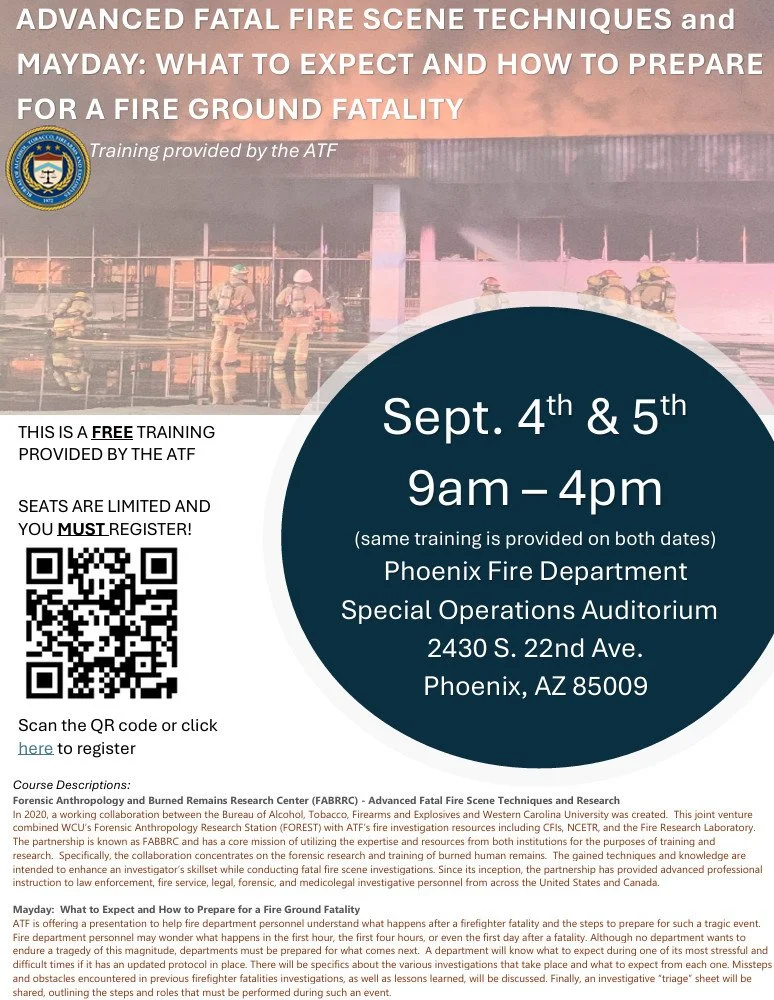
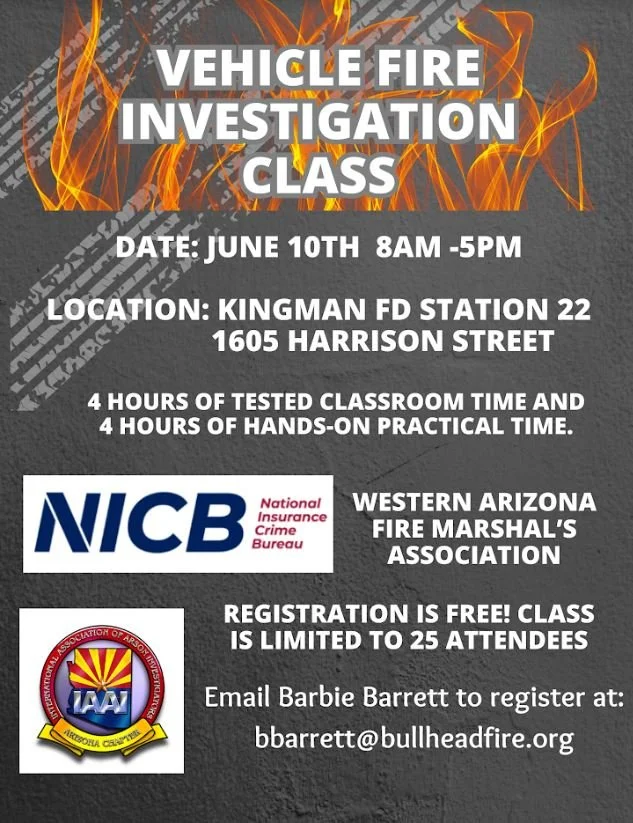
Annual Training Conference
The event formerly known as “Advanced Arson” is now the “Annual Training Conference”!

Helping one of our own!
Tyson Matheny
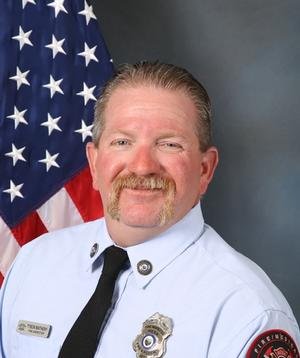
At the holidays we usually exchange good tidings and wish us all well in the next year of code enforcement. I still certainly do to each one of you but I have some unfortunate news to share as well. This past Sunday, Mesa Fire Inspector/Investigator Tyson Matheny was struck by an automobile while riding his motorcycle in East Mesa. His injuries are very serious. He is currently at Banner Desert Hospital in Mesa. To this point he has had three surgeries with more to come. Notwithstanding, he is being very strong and fully intends to eventually return to duty. He will have many months of recovery time. A Go Fund Me page has been started and we are asking you all to consider helping him if you are able.
https://gofund.me/7138e8ed
Send questions, prayers, or words of encouragement to helptysonm@gmail.com
*12/21/2023 Update* - Tyson is doing well and has been moved to Banner Rehab in Mesa (1702 S Pierpont)